
The Cross-Border Retiree Coordinating CPP/OAS and Social Security
By Bryant Andrus
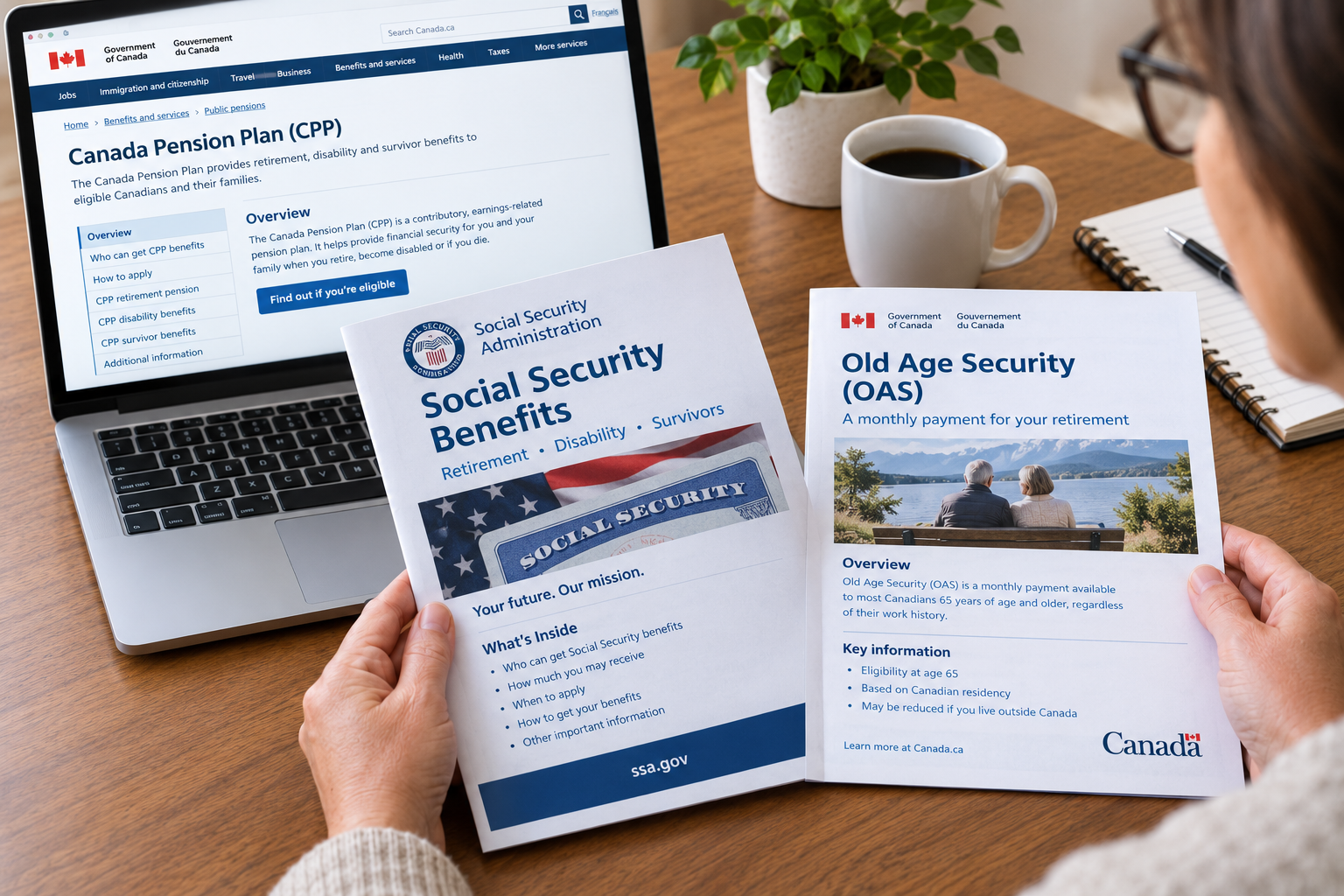
Profile: The Cross-Border Retiree Coordinating CPP/OAS and Social Security
TL;DR
- Retirees with CPP/OAS and US Social Security entitlements hold one of the most under-optimized income situations in cross-border planning.
- For US residents, CPP and OAS are taxable only in the US and are treated just like Social Security — so no more than 85% is includable.
- CPP deferral needs a currency lens, and the Totalization Agreement can bridge eligibility gaps and settle which system your contributions belong to.
If you’ve spent part of your career in Canada and part in the United States — or if your spouse did — and you’re now approaching retirement with entitlements in both the Canada Pension Plan and US Social Security, you are sitting on one of the most under-optimized income situations in cross-border planning. The good news: it’s very fixable. The challenge: every decision you make about timing, residency, and withdrawal sequencing affects the other.
August is when snowbirds start planning their winter, when the CUSMA picture is still unsettled, and when retirees or near-retirees typically take stock of the year. It’s an ideal time to address the CPP/OAS and Social Security coordination question — because the decisions made in the year before benefits begin are the ones that are hardest to reverse.
The Treaty Determines Who Taxes What
The Canada-US Tax Convention determines which country has the right to tax your government pensions. For Canadian residents, CPP and OAS are taxed in Canada — that’s straightforward. But for US residents receiving CPP and OAS, the treaty generally exempts those payments from Canadian non-resident withholding tax and makes them taxable only in the US, where they are treated as if they were US Social Security benefits. Because no Canadian withholding applies, the full gross amount is received by the US resident and reported on their US return alongside any Social Security benefits. That means CPP, OAS and Social Security are combined and taxed the same way: depending on your other income, none, up to 50%, or at most 85% of the benefits is includable in income.
Deferral: The Currency Dimension
The conventional wisdom on CPP deferral — delay to age 70 for the 8.4% annual enhancement — remains mathematically sound on a break-even basis. But currency adds a dimension that most retirement calculators ignore. If the Canadian dollar strengthens from current levels, locking in a larger future CPP payment through deferral becomes more valuable in US-dollar terms. If it doesn’t recover, a larger stream of low-value Canadian dollars may not achieve the US-dollar retirement income you need.
The Totalization Agreement
The Canada-US Totalization Agreement prevents double contributions to both social security systems for the same period of work, and allows periods of contribution in both countries to be combined for eligibility purposes. For someone who worked 25 years in Canada and 5 years in the US, the Totalization Agreement can bridge the gap to US Social Security eligibility. For someone at risk of contributing to both systems for the same work — such as an employee temporarily sent across the border by their employer, or a self-employed person with ties to both countries — the agreement determines which system’s contributions apply. Understanding how your specific contribution history is being treated is essential to optimizing your retirement income.
Ready to Talk?
Cross-border planning is time-sensitive and highly fact-specific. If any of the topics in this issue apply to your situation, we would welcome the conversation. State Bird Corp specializes in US–Canada cross-border tax, estate, and immigration planning for families and businesses on both sides of the border. Our team works with clients across the US and Canada — wherever your cross-border life takes you.
Sources
- https://www.irs.gov/publications/p915
- https://laws-lois.justice.gc.ca/eng/acts/C-10.7/page-6.html
- https://www.ssa.gov/international/Agreement_Pamphlets/documents/Canada.pdf
- https://thehub.ca/2026/08/26/canada-u-s-trade-deal-collapse-explained-why-it-failed-whos-to-blame-and-the-economic-cost-of-an-extended-trade-war/
- https://www.bankofcanada.ca/rates/exchange/monthly-exchange-rates/
- https://www.canada.ca/en/services/benefits/publicpensions/cpp/when-start.html
- https://www.canada.ca/en/revenue-agency/services/forms-publications/publications/t4155/t4155-old-security-return-income-guide-non-residents.html
Sincerely,
The State Bird Corp Team
State Bird Corp
P: (602) 641-5996 · E: Info@statebirdcorp.com · W: statebirdcorp.com
To schedule your initial consultation, please contact us at info@statebirdcorp.com so that we can help you create a plan as unique as your fingerprint.
State Bird Corp is a management and financial consulting firm. State Bird Corp is not an accounting, legal or investment advisory firm. Cross-border planning is highly fact-specific. The strategies and topics described are general in nature, and readers should consult qualified specialists before taking any action. Any recommendation, inferences, or other guidance contained herein is meant for educational or general purposes and should not be relayed upon as specific advice for any person or business. Consult your legal, tax, and investment advisor for specific recommendation to your situation.